The mighty Delegate.CreateDelegate
The System.Delegate.CreateDelegate method has been available since the earliest versions of the .NET Framework. It creates a delegate dynamically from a delegate type, supplied as a System.Type, and a method, identified by its name or a System.Reflection.MethodInfo. What makes it interesting is the variety of ways it can bind a method to a delegate signature.
Consider the following class and struct:
class FooClass
{
  public static void StaticBar(object x) { }
  public string InstanceBar(int x) { return "abc"; }
}

struct FooStruct
{
  public void InstanceBoo(int x) { }
}
Here are the kinds of delegates we can create:
-
A delegate for a static method
In C#, we can create an
Action<object>delegate fromFooClass.StaticBarusing a method group:Action<object> staticBar = FooClass.StaticBar;The equivalent call to
Delegate.CreateDelegateis:var staticBar = (Action<object>) Delegate.CreateDelegate( type: typeof(Action<object>), method: typeof(FooClass).GetMethod("StaticBar")); -
A delegate for an instance method
C# also supports binding a delegate to a particular object:
Func<int, string> instanceBar1 = new FooClass().InstanceBar;With
Delegate.CreateDelegate, the additionalfirstArgumentparameter supplies the object on which the instance method will be invoked:var instanceBar = (Func<int, string>) Delegate.CreateDelegate( type: typeof(Func<int, string>), method: typeof(FooClass).GetMethod("InstanceBar"), firstArgument: new FooClass()); /* <== */Instance methods on value types are supported too. In this case, the struct is boxed:
var instanceBoo = (Action<int>) Delegate.CreateDelegate( type: typeof(Action<int>), method: typeof(FooStruct).GetMethod("InstanceBoo"), firstArgument: new FooStruct()); /* <== */ -
Contravariant parameter types
C# supports contravariance in parameter types when converting a method group to a delegate. For example, a method with this signature:
private void Foo(object sender, EventArgs e)can handle an event whose delegate has this signature:
void PropertyChangedEventHandler(object sender, PropertyChangedEventArgs e)This works because
PropertyChangedEventArgsderives fromEventArgs. Likewise, the following conversion is valid becausestringderives fromobject:Action<string> contravariantParameterType = FooClass.StaticBar;Delegate.CreateDelegatesupports the same parameter contravariance:var contravariantParameterType = (Action<string>) Delegate.CreateDelegate( type: typeof(Action<string>), method: typeof(FooClass).GetMethod("StaticBar")); -
Covariant return types
C# also supports covariance in the return type:
Func<int, object> covariantReturnType = new FooClass().InstanceBar;The same conversion works with
Delegate.CreateDelegate:var covariantReturnType = (Func<int, object>) Delegate.CreateDelegate( type: typeof(Func<int, object /* <== */>), method: typeof(FooClass).GetMethod("InstanceBar"), firstArgument: new FooClass()); -
An open instance delegate for a reference type
An open instance delegate exposes the target object as its first argument. C# cannot create one directly through a method group conversion. With
Delegate.CreateDelegate, we omitfirstArgumentand choose a delegate type whose first parameter is the reference type declaring the method. The instance method can then be called through the delegate as though it were static:var instanceBarAsStatic = (Func<FooClass, int, string>) Delegate.CreateDelegate( type: typeof(Func<FooClass /* <== */, int, string>), method: typeof(FooClass).GetMethod("InstanceBar"));The same delegate can be invoked on different objects:
var foo1 = new FooClass();
var foo2 = new FooClass();

instanceBarAsStatic(foo1, 1);
instanceBarAsStatic(foo2, 2);
instanceBarAsStatic(null, 3); // null reference exception?
There is a subtle difference from an ordinary C# instance call: the delegate invocation does not automatically check whether the target object (
this) isnull. The third call therefore succeeds for this method, which does not access any instance state: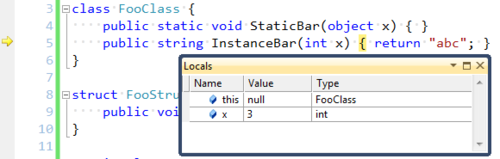
Do not rely on this form of invocation to reject a
nulltarget. -
A static delegate with a bound first argument
We can also bind the first argument of a static method. Supply
firstArgumentwhen creating the delegate, and omit the corresponding parameter from the delegate type:var staticBarWithFixedArg = (Action) Delegate.CreateDelegate( type: typeof(Action), method: typeof(FooClass).GetMethod("StaticBar"), firstArgument: new object()); /* <== */The delegate retains the
new object()instance and supplies it as the first argument on every call. For this form of binding, the method’s first parameter must be a reference type. This is partial application: one argument is fixed when the delegate is created. -
An open instance delegate for a value type
I discovered this possibility while thinking about how instance methods on C# structs work. For a struct instance method,
thisbehaves like arefparameter; in a struct constructor, it behaves like anoutparameter. It can even be assigned to. That suggests defining a delegate whose first parameter is a reference to the struct. The standardActionandFuncdelegate types do not supportreforoutparameters, so we need our own type:delegate void FooStructBooRef(ref FooStruct foo, int x);We can then create the delegate without supplying
firstArgument:var instanceBooAsStaticWithRef = (FooStructBooRef) Delegate.CreateDelegate( type: typeof(FooStructBooRef /* <== */), method: typeof(FooStruct).GetMethod("InstanceBoo"));This works, and lets us pass a different struct variable on each call:
var foo1 = new FooStruct();
var foo2 = new FooStruct();

instanceBooAsStaticWithRef(ref foo1, 1);
instanceBooAsStaticWithRef(ref foo2, 2);
The first parameter can also be declared as
out. At the CLR level, bothrefandoutare represented as by-reference parameters; the distinction is recorded in metadata and enforced by the C# compiler. However, methods such asGetHashCode,Equals, andToStringthat the struct inherits rather than overrides still require boxing, so they cannot be bound in this way.