F# array/list sequence expressions performance
While reading sections 6.3.13 and 6.3.14 of the F# specification, I came across these statements about list [ ] and array [| |] expressions, also known as list and array comprehensions:
- In all cases
[ cexpr ]elaborates toFSharp.Collections.Seq.toList(seq { cexpr }). - In all cases
[| cexpr |]elaborates toFSharp.Collections.Seq.toArray(seq { cexpr }).
This surprised me. Lists and arrays differ fundamentally from seq sequences, which are lazy. Supporting that laziness requires the compiler to generate a substantial amount of code: a state machine, much like the one generated for yield return iterators in C#. It splits the sequence expression into states and keeps its local variables in captured state.
That overhead makes sense for a lazy sequence. But what about arrays and lists? When I first learned F#, I assumed that [ ] and [| |] would produce more efficient code than seq { }, since they do not need the machinery for deferred execution. The specification suggested otherwise.
I wanted to see whether a custom computation expression builder could avoid this overhead by constructing arrays and lists eagerly. In general, F# compiles computation expressions into calls to builder methods, passing nested lambda expressions as arguments. Sequence expressions are a special case: the compiler generates an optimized state machine for seq { }. Could an eager builder outperform that optimized but lazy implementation?
It turns out that it can. The key is that F# allows inline on member declarations as well as let bindings. Making the builder’s methods inline eliminates many, though not all, of the lambdas. The resulting code constructs the collection in an almost imperative fashion, without deferred execution. I started with an alternative to [| |], using the standard .NET List<'T> class:
type FastArrayBuilder<'a>() =
  inherit System.Collections.Generic.List<'a>()

type FastArrayBuilder<'a> with
  member inline arr.Yield(x)       = arr.Add(x)
  member inline arr.YieldFrom(xs)  = arr.AddRange(xs)
  member inline arr.Run(f)         = f(); arr.ToArray()
  member inline arr.Combine((), f) = f()
  member inline arr.Delay(f)       = f
  member inline arr.Zero()         = ()
  member inline arr.For(seq, f)    = for x in seq do f x
  member inline arr.Using(expr, f) = use e = expr in f e
  member inline arr.While(cond, f) = while cond() do f()
  member inline arr.TryWith(t, f)  = try t() with e -> f()
  member inline arr.TryFinally(t, f) = try t() finally f()

let inline fastarray<'a> = FastArrayBuilder<'a>()
The builder inherits directly from List<'T>, but all its members are defined in a type extension. This works around a limitation in the F# compiler: it rejects calls to public members inherited from CLI types inside these inline definitions, while accepting the same calls in a type extension. This may be a compiler bug.
Also, fastarray is a type function. Each fastarray expression needs to start with a fresh, empty List<'T>. Every reference to the value fastarray is compiled as another evaluation of FastArrayBuilder<'a>(), creating a new list instance.
Let’s compare the two approaches using a reasonably complex array expression. The benchmark repeats the same code for each builder:
Measure.run [

  "[| |]", fun() ->
    [|
      yield 1; yield 2; yield! {3 .. 4}
      let x1 = 123
      try for i = 1 to 10 do
            if i < 5 then yield i
                          yield! [ x1 ]
            else yield! [| 1; 2; i |]
          yield 777
      finally ()
      for i in 0 .. 10 do
        if i % 2 = 0 then yield! [1]
      yield 99
    |]
    |> ignore

  "fastarray { }", fun() ->
    fastarray {
      yield 1; yield 2; yield! {3 .. 4}
      let x1 = 123
      try for i = 1 to 10 do
            if i < 5 then yield i
                          yield! [ x1 ]
            else yield! [| 1; 2; i |]
          yield 777
      finally ()
      for i in 0 .. 10 do
        if i % 2 = 0 then yield! [1]
      yield 99
    }
    |> ignore
]
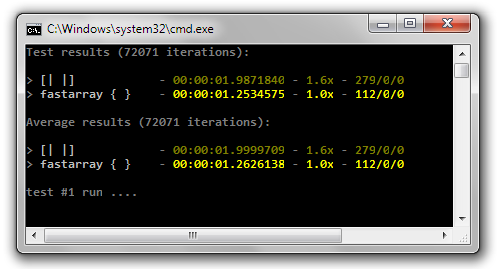
Here are the results. Across different expressions, I measured speedups of 1.5–3 times over [| |]. Pay particular attention to the garbage collection counts in the last column:
What about lists, one of the foundations of F#? Since [ ] expressions also use seq { }, let’s try an alternative builder for them:
[<Struct>]
type FastListBuilder<'a> =
  new _ = { tail = [] }
  val mutable tail : 'a list

  member inline list.Yield(x) =
    list.tail <- x :: list.tail
  member inline list.YieldFrom(xs) =
    for x in xs do list.tail <- x :: list.tail
  member inline list.Run(f) =
    f(); List.rev list.tail

  member inline list.Combine((), f) = f()
  member inline list.Delay(f)       = f
  member inline list.Zero()         = ()
  member inline list.For(seq, f)    = for x in seq do f x
  member inline list.Using(expr, f) = use e = expr in f e
  member inline list.While(cond, f) = while cond() do f()
  member inline list.TryWith(t, f)  = try t() with e -> f()
  member inline list.TryFinally(t, f) = try t() finally f()

let inline fastlist<'a> = FastListBuilder<'a>(1)
This implementation takes a different approach. The builder is a value type, which reduces indirection, and stores a mutable reference to the list accumulated so far. Each yield or yield! prepends elements to that list. This builds the list in reverse order, so Run has to reverse it before returning the result. Inside the F# standard library, we could mutate list nodes to build the list in the right order directly, but that option is not available in user code. Here is the benchmark:
Measure.run [

  "[ ]", fun() ->
    [
      yield 1; yield 2; yield! {3 .. 4}
      let x1 = 123
      try for i = 1 to 10 do
            if i < 5 then yield i
                          yield! [ x1 ]
            else yield! [| 1; 2; i |]
          yield 777
      finally ()
      for i in 0 .. 10 do
        if i % 2 = 0 then yield! [1]
      yield 99
    ]
    |> ignore

  "fastlist { }", fun() ->
    fastlist {
      yield 1; yield 2; yield! {3 .. 4}
      let x1 = 123
      try for i = 1 to 10 do
            if i < 5 then yield i
                          yield! [ x1 ]
            else yield! [| 1; 2; i |]
          yield 777
      finally ()
      for i in 0 .. 10 do
        if i % 2 = 0 then yield! [1]
      yield 99
    }
    |> ignore
]
Even with the cost of reversing the list, the results are encouraging: there are fewer than half as many generation 0 garbage collections:
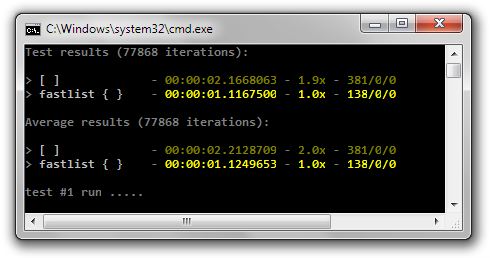
The improvement is worth considering. Immutable lists are fundamental to a functional language such as F#, and a core feature like list comprehensions should be as efficient as possible.
P.S. There are still scenarios where the current translation through seq { } makes sense. Can you think of any?